The new Assignment Builder makes it easy to write your own exercises! Although all of the Runestone books have a pretty good selection of exercises, you can never have too many exercises. We hope to crowd source an enormous collection of questions and problems in our Exercise database. You can help by adding custom exercises for your own course to the database! Once your exercise is in the database, it is available for others to find using the search feature on the create assignment page. Community contributed exercises are shown with a person icon instead of a book icon under the source column.
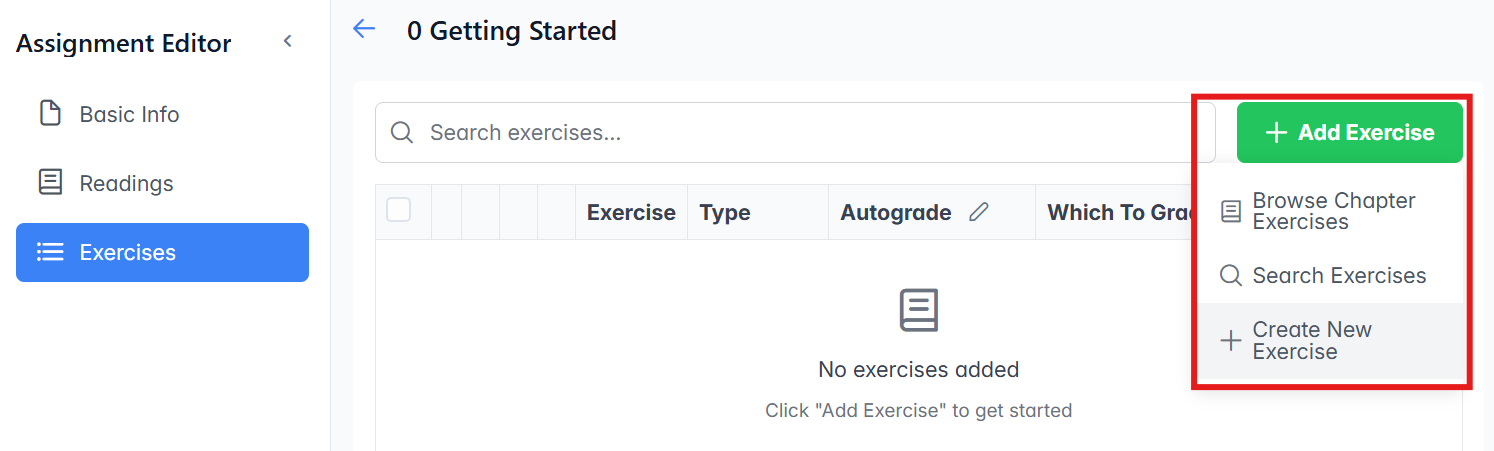
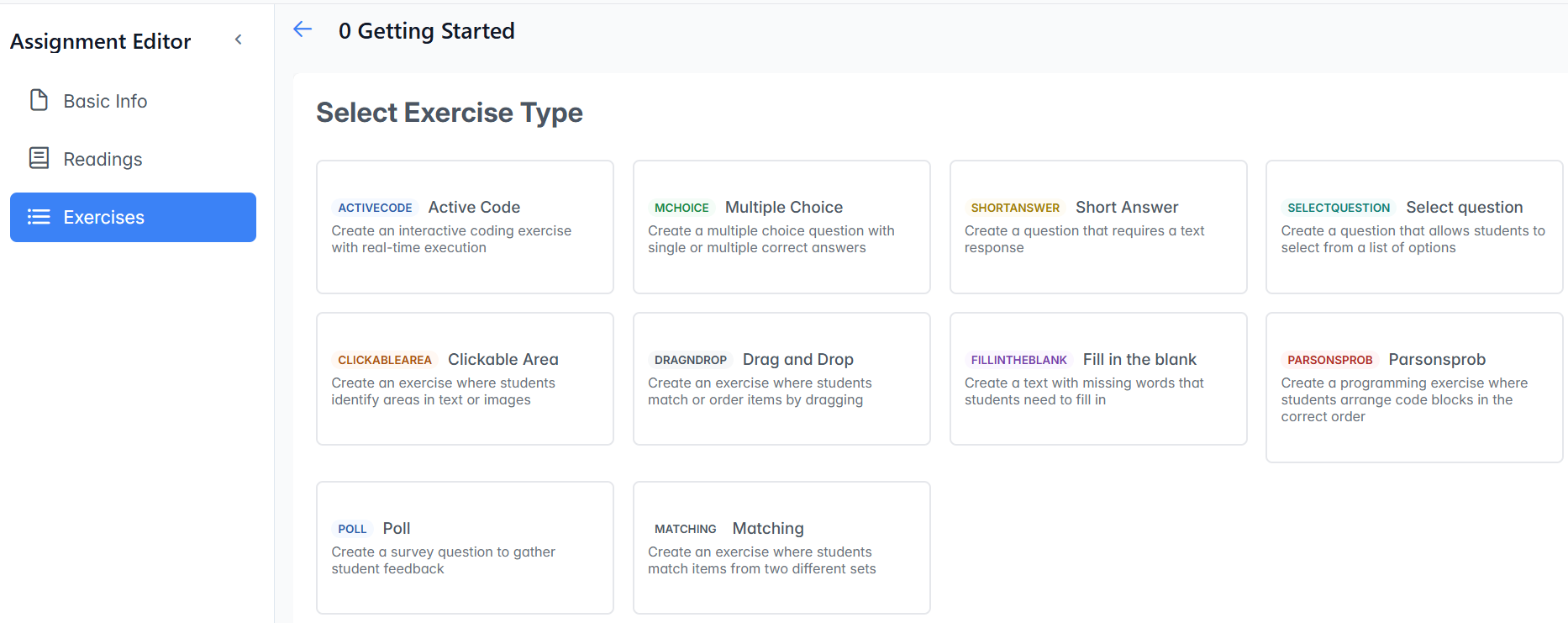
To create new exercises, start or go to any assignment in the Instructor Dashboard "Assignment Builder". In the Exercises section of the assignment, click on "Add Exercise" and select "+ Create New Exercise".
This would be true if it was System.out.println(((2 + 3) * 5) - 1), but without the parentheses the multiplication is done first.
14
This would be true if it was System.out.println(2 + (3 * (5 - 1))), but without the parentheses the multiplication is done first and the addition and subtraction are handled from left to right.
This will give a compile time error.
This will compile and run. Try it in DrJava. Look up operator precedence in Java.
16
Correct! Remember PEMDAS. The multiplication is done first (3 * 5 = 15) and then the addition (2 + 15 = 17) and finally the subtraction (17 - 1 = 16).
The following has all the correct Java code to print out “Hi there!” when the code is run, but the code is mixed up and contains some extra blocks with errors. Drag the needed blocks from left to right and put them in the correct order. Click on the “Check Me” button to check your solution.
Constructors are public and have the same name as the class. Click on the constructor headers which are the first line of the constructors showing their name and parameters.
public class Date {private int year;private int month;private int day;public Date(){ /** Implementation not shown */ }public Date(int year, int month, int day){ /** Implementation not shown */ }public void print(){ /** Implementation not shown */ }}
Write an algorithm for someone (maybe a robot) to make a peanut butter and jelly sandwich. Be sure to include at least 5 precise steps in order. Have someone (maybe your instructor) act it out. Were your instructions precise enough?